See it done
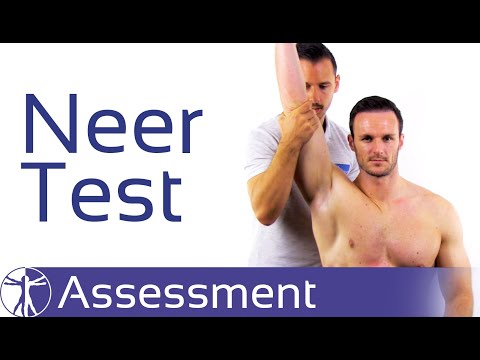
A demonstration by Physiotutors on YouTube (2:14). GymEd didn't make it, so where it differs from the steps below, follow the steps.
How to run it
- Client sits upright with the arm relaxed by the side. Stand beside or behind the side to be tested.
- Put one hand on top of the shoulder to stop the shoulder blade lifting and turning.
- With the other hand, lift the client's straight arm forward and up (passive forward flexion) to the end of range, smoothly and without force. Some examiners turn the arm in (thumb down) first: use the same version each time.
- Ask whether this brings on their usual shoulder pain and where they feel it. Test the other side the same way to compare.
- Positive: the client's familiar shoulder pain, usually at the front of the shoulder, at or near the end of the lift. It suggests subacromial (rotator cuff related) shoulder pain, but it is a weak test on its own. This is the Neer sign, not the Neer injection test.
Equipment
Chair or plinth for the client to sit on
Safety
Skip it with a suspected fracture, a recent dislocation or severe pain on lifting the arm. Lift smoothly and stop at the end of comfortable range. A positive is one finding, not a diagnosis: read it with the history and other tests.
How accurate is it
- Subacromial pain (impingement syndrome)
- Sensitivity 0.73, specificity 0.52, LR+ 1.54, LR- 0.47 (Zhao 2024, PMID 39702033; Adults with shoulder symptoms seen in shoulder clinics)
Sensitivity is how often the test is positive when the problem is there. Specificity is how often it is negative when it is not. Each figure comes from the study named, in its group of people and against its reference standard. A positive is one finding, not a diagnosis.
Reliability
- ICC
- Inter-rater kappa 0.86 with anterior pain as the sign (44 overhead athletes, two examiners; Vind 2011, PMID 22021736); 0.39 to 0.40 grouped with Hawkins-Kennedy (55 clinic patients; Michener 2009, PMID 19887215)
Each figure comes from the study named beside it, in that study's population and protocol. Check they match your clients before you read a change as real.
Sources
- Protocol Neer CS 2nd. Anterior acromioplasty for the chronic impingement syndrome in the shoulder: a preliminary report. J Bone Joint Surg Am 1972;54(1):41-50. PMID 5054450 Neer CS 2nd. Impingement lesions. Clin Orthop Relat Res 1983;(173):70-7. PMID 6825348 Vind M, Bogh SB, Larsen CM, et al. Inter-examiner reproducibility of clinical tests and criteria used to identify subacromial impingement syndrome. BMJ Open 2011;1(1):e000042. PMID 22021736 (standardised description used here)
- Reference Physiopedia