
The record your NDIS progress report is written from.
Every session your participants complete is logged as it happens. Completion, pain and effort, across the whole plan period.
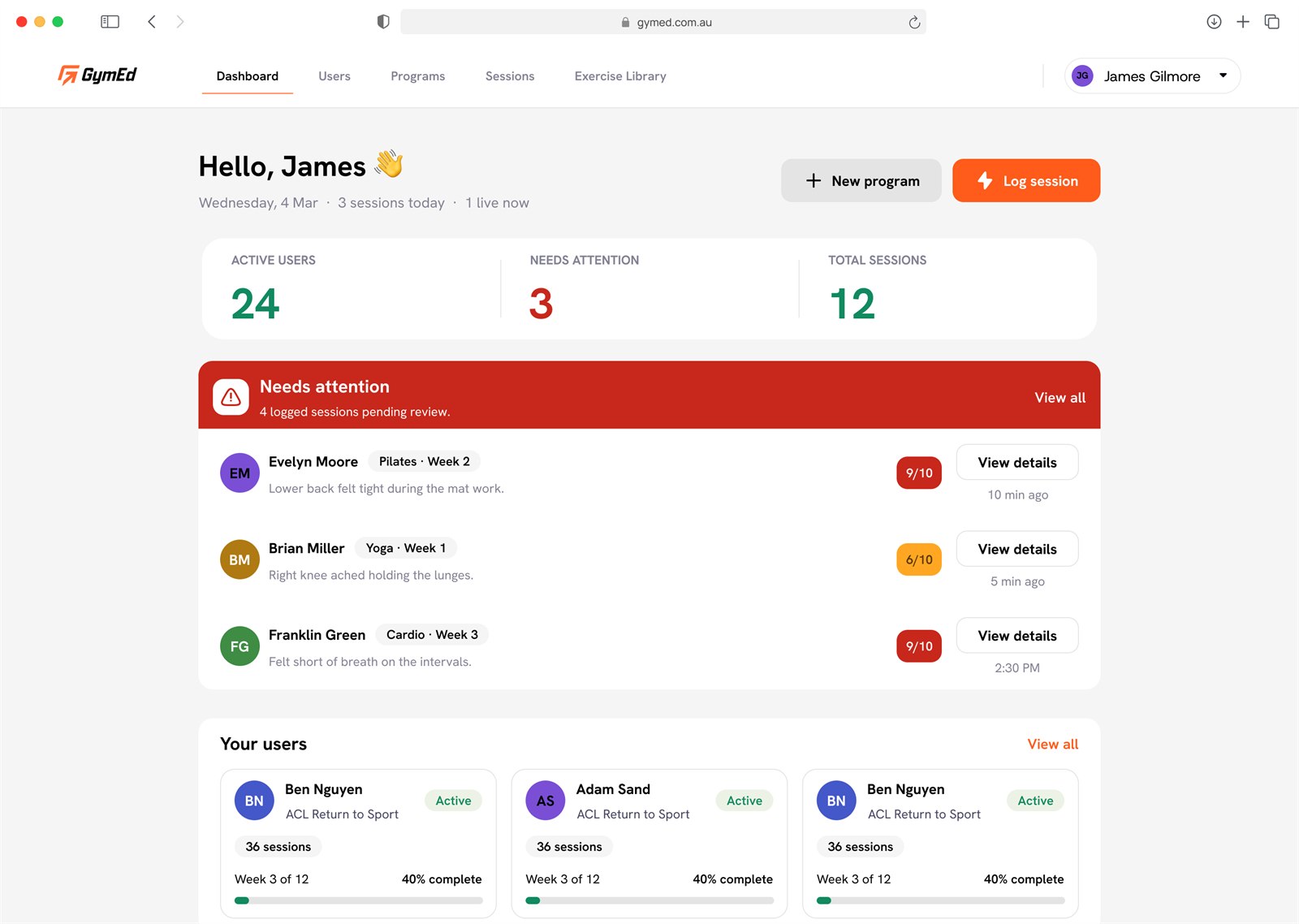
Your caseload, with flagged sessions surfaced first.
What the record actually looks like.
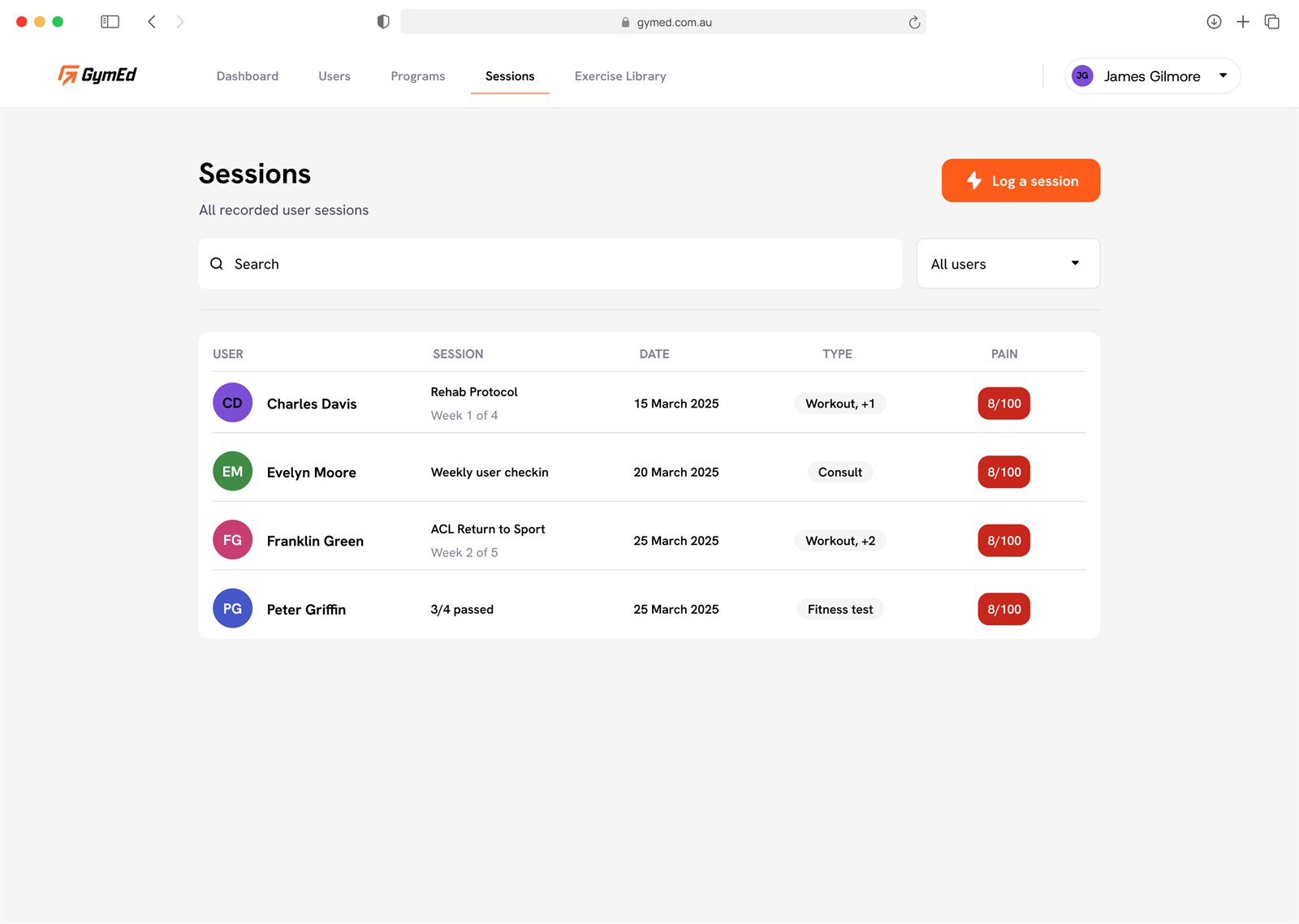
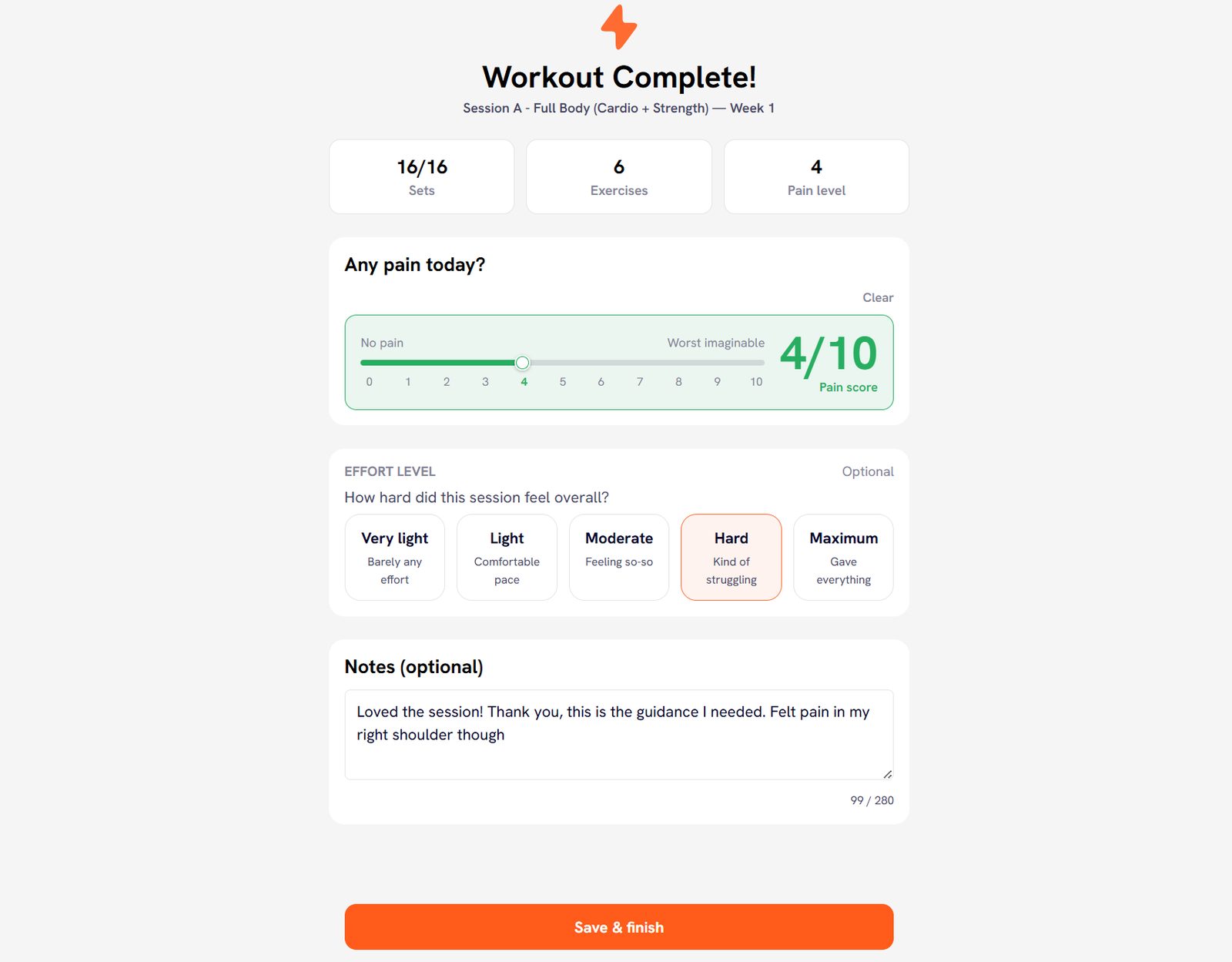
Every session a participant completes is logged as it happens. Dated, with completion, effort and pain, on one screen.
Before
Program in one place, notes in another, progress reconstructed the night before.
After
One record per participant, built session by session, printable in one click.
Your price ceiling was cut on 1 July.
Down $5.00 an hour, from 1 July 2026
The national NDIS price limit for exercise physiology fell from $166.99 to $161.99 per hour. That is a benchmarking decision, not indexation.
"The national price for supports delivered by an Exercise Physiologist should be a maximum of $161.99 per hour."
The cap is now set against what Medicare and private health insurers actually pay. Which makes the hours you do not spend on admin worth more than they were in June.
Source
Source: NDIA, Annual Pricing Review for 2026-27 prices, section 8.6.4 and Recommendation 7. The $161.99 figure is the national rate and is confirmed in the NDIS Pricing Schedule 2026-27, effective 1 July 2026. Remote and very remote loadings still apply. Therapy prices are re-set each July, so confirm current figures in the NDIS Pricing Schedule before you quote or invoice.One flat price for the whole team.
- One record per participant, whoever on the team delivered the session.
- Your best programs become shared starting points, so juniors build from approved frameworks.
- When a practitioner takes leave or moves on, their participants' programs stay.
a month, flat. Up to 10 practitioners, unlimited participants.
Professional is $24.99 a month for one practitioner.
What the NDIA asks a therapy progress report to cover.
The wording is the NDIA's own and is addressed to the participant, so "you" means your client.
"We may ask your therapist to give us progress reports if we need to reassess your plan." A progress report should include:
Tick the ones you could evidence today, from records you already hold.
Every participant, app or paper.
Some participants will not, or cannot, use an app. One click prints the program. You log the session yourself, and back-date it, so the record still builds.
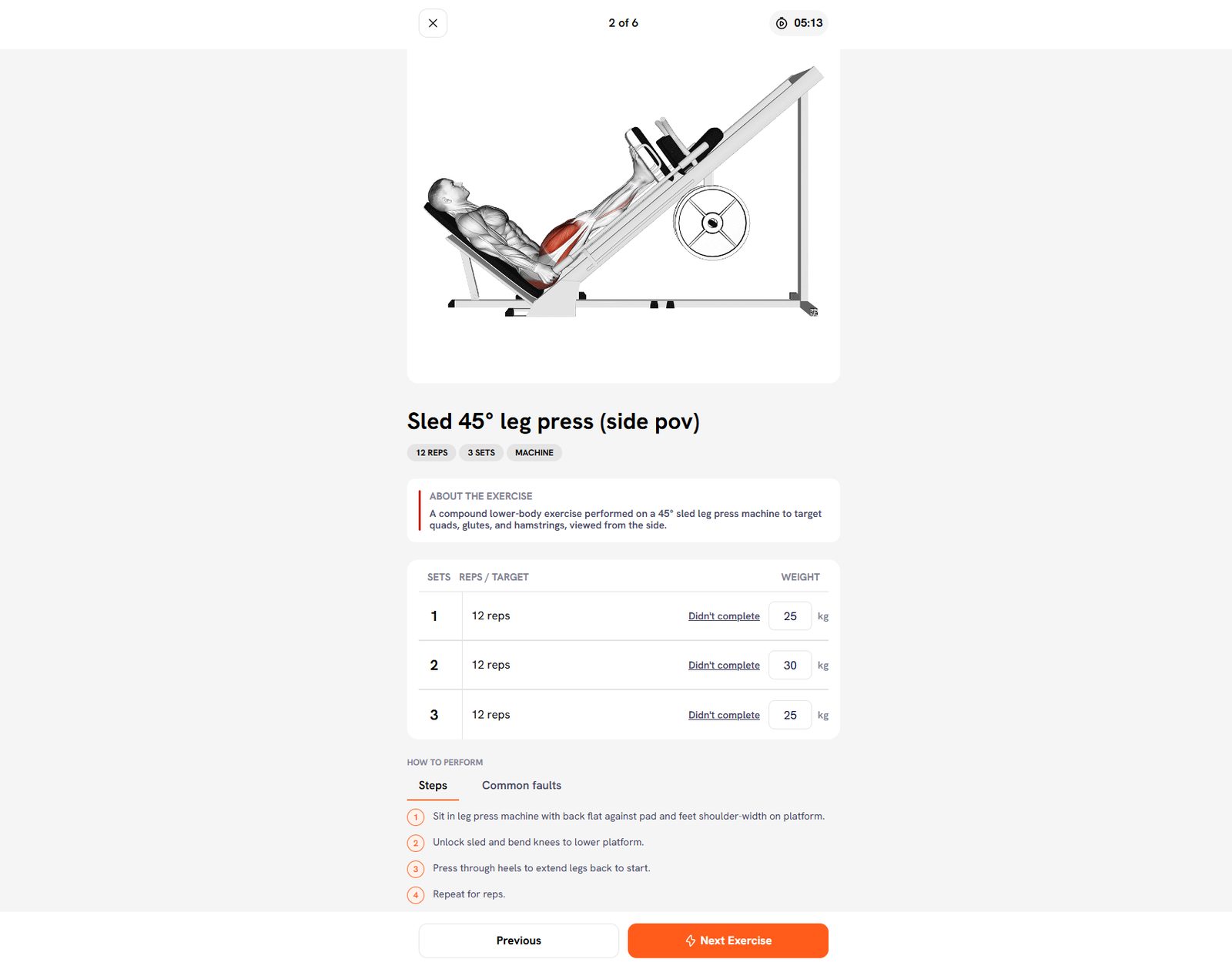
Same record underneath, either way.
The measures the NDIA names by example.
In its guidance for allied health professionals writing a plan reassessment report, the NDIA says:
"Describe the assessment measures you used to quantify their functional capacity. For example, the Timed Up and Go test (TUG), the 6-minute walk test or the Berg Balance Scale (BBS) provide evidence of the therapies you have trialled."
Standardised testing library
Timed Up and Go, the 6-minute walk test and the Berg Balance Scale with guided delivery, scoring and norm bands. In build now, not part of the product today.
Our free resource library links to all three today, alongside the screening and outcome-measure tools that go with them.

Built by an Accredited Exercise Physiologist.
Riley Steffen is an ESSA Accredited Exercise Physiologist and a secondary teacher. Same registration as you, same reassessment reports, same admin at the end of it.
 Riley Steffen · Founder, GymEd
How the process actually works.
NDIS plans are not renewed. At the reassessment date the NDIA has four paths open to it.
Reassess
A new plan replaces the current one.
Vary
Part of the current plan changes. No full reassessment.
Not reassess
The NDIA decides not to reassess.
Continue
Another 12 months, same core and capacity building amounts, indexed. Unspent funding carries over.
No plan meeting is needed for a variation or a continuation.
Check-in, 2 to 3 months out.
The plan's own reassessment date.
A new plan, a variation, or a continuation.
A participant, nominee or child representative can ask earlier, but only if support needs have changed significantly and on an ongoing basis, with recent evidence. A provider cannot lodge it.
Sources
Source: current NDIS guidance at ndis.gov.au, plan reassessment, plan variation and guide to your next plan. Checked 14 September 2026. The NDIA is updating its guidance for new legislation, so check ndis.gov.au for the current position. Source: NDIS, Guide to your next plan, and Our Guideline: Your plan (3 September 2026). Checked 14 September 2026.Start with one participant. Decide for the whole team.
Fourteen days, no credit card. Build one program, log a couple of sessions, and see what the record looks like.
One short form. Name, email, practice.
Riley reviews it personally and sets you up.
Your login lands by email.
Optional onboarding call if you want one.