See it done
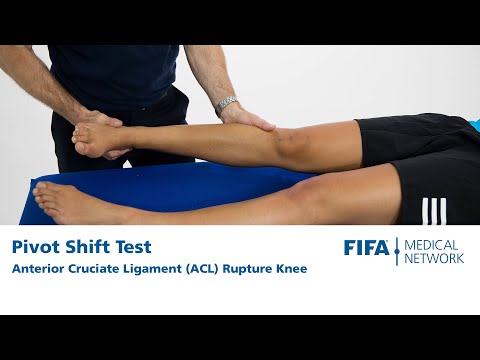
A demonstration by FIFA on YouTube (1:06). GymEd didn't make it, so where it differs from the steps below, follow the steps.
How to run it
- Client lies on their back, relaxed. Lift the leg with the knee straight and the hip bent about 30 to 40 degrees. Stand on the side being tested (the pivot shift, from a straight knee into bending).
- Hold the foot or ankle with one hand and turn the shin inward. Place the other hand on the outside of the top of the shin, just below the knee.
- Keep the shin turned in and push the knee gently inward (a valgus force).
- Slowly bend the knee from straight, keeping both forces on.
- Repeat on the other knee and compare.
- Positive: the top of the shin sits slipped forward near straight, then jumps back into place with a clunk or shift at about 30 to 40 degrees of bend. It suggests an ACL tear with rotational instability.
Equipment
Examination bed or plinth
Safety
Do not test if a fracture (Ottawa knee rule) or a knee dislocation is suspected: check foot pulses and feeling, and refer. Stop if the client cannot relax: guarding often hides a positive, and the test can be uncomfortable. A positive is one finding, not a diagnosis: read it with the history and other tests. Done by clinicians trained in the test.
How accurate is it
- ACL tear (partial or complete) without concomitant knee ligament injury
- Sensitivity 0.55, specificity 0.94, LR+ 10.7, LR- 0.48 (Sokal 2022, PMID 35150292; Awake patients, no arthrometry; non-obstructive meniscal tears allowed; bivariate model)
Sensitivity is how often the test is positive when the problem is there. Specificity is how often it is negative when it is not. Each figure comes from the study named, in its group of people and against its reference standard. A positive is one finding, not a diagnosis.
Reliability
- Reliability
- kappa 0.84 inter-rater for positive vs negative, surgeon then blinded physiotherapist within a week (35 knee-trauma patients aged 16 and over; Lichtenberg 2018, PMID 29568784); 0.39 inter-observer for the classic grades (four observers, 17 patients; Martinez-Cano 2025, PMID 40766805)
Each figure comes from the study named beside it, in that study's population and protocol. Check they match your clients before you read a change as real.
Sources
- Protocol Galway HR, MacIntosh DL. The lateral pivot shift: a symptom and sign of anterior cruciate ligament insufficiency. Clin Orthop Relat Res 1980;(147):45-50. PMID 7371314 Sokal PA, Norris R, Maddox TW, Oldershaw RA. The diagnostic accuracy of clinical tests for anterior cruciate ligament tears are comparable but the Lachman test has been previously overestimated: a systematic review and meta-analysis. Knee Surg Sports Traumatol Arthrosc 2022;30(10):3287-3303. PMID 35150292
- Reference Physiopedia