See it done
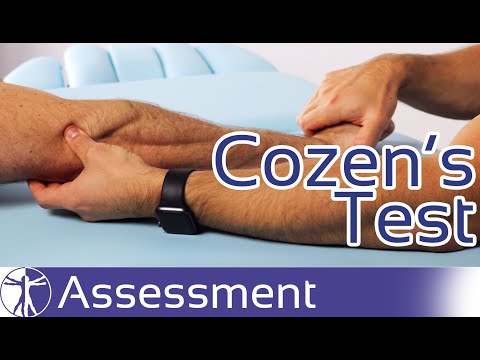
A demonstration by Physiotutors on YouTube (2:28). GymEd didn't make it, so where it differs from the steps below, follow the steps.
How to run it
- Version: Cozen's test with the elbow straight, as used in recent accuracy studies (some clinicians test with the elbow bent to 90 degrees). The client sits with the arm supported, elbow fully straight and forearm turned palm down.
- The client makes a fist and tilts the hand towards the thumb side.
- The examiner steadies the elbow with one hand, thumb resting on the bony point at the outer elbow (lateral epicondyle), and places the other hand on the back of the client's fist.
- The client lifts the wrist back against the examiner's hand while the examiner resists, building up steadily rather than suddenly.
- Repeat on the other arm for comparison.
- Positive: the client's familiar pain at the outer elbow (lateral epicondyle) comes on during the resisted lift. This suggests the wrist extensor tendons at the outer elbow are the pain source (lateral elbow tendinopathy).
Equipment
None (examiner's hands); a chair for the client
Safety
Do not do it after a recent elbow fracture, dislocation or surgery, or on a hot, swollen elbow. Stop if pain is severe or tingling spreads down the forearm. A positive is one finding, not a diagnosis: read it with the history and other tests.
How accurate is it
- lateral elbow tendinopathy
- Sensitivity 0.91 (Karanasios 2022, PMID 33814224 (primary: Dones 2014, J Case Rep Clin Res Stud 1(1):1-15, not in PubMed); review of 24 studies (2 of physical examination tests); the 91% comes from Dones 2014: 54 consecutive participants with lateral elbow pain)
Sensitivity is how often the test is positive when the problem is there. Specificity is how often it is negative when it is not. Each figure comes from the study named, in its group of people and against its reference standard. A positive is one finding, not a diagnosis.
Sources
- Protocol Cozen L. The painful elbow. Ind Med Surg. 1962;31:369-71. PMID 13881925 Factor S, Snopik PG, Albagli A, Rath E, Amar E, Atlan F, et al. The "Selfie Test": a novel test for the diagnosis of lateral epicondylitis. Medicina (Kaunas). 2023;59(6):1159. PMID 37374364. doi 10.3390/medicina59061159 Karanasios S, Korakakis V, Moutzouri M, Drakonaki E, Koci K, Pantazopoulou V, et al. Diagnostic accuracy of examination tests for lateral elbow tendinopathy (LET): a systematic review. J Hand Ther. 2022;35(4):541-551. PMID 33814224. doi 10.1016/j.jht.2021.02.002 Satake H, Naganuma Y, Honma R, Shibuya J, Maruyama M, Takagi M. The effect of elbow and forearm position on the resisted wrist extension test and incidence of sensory disturbance of the superficial radial nerve in patients with lateral epicondylitis. J Hand Surg Asian Pac Vol. 2022;27(4):665-671. PMID 35965378. doi 10.1142/S2424835522500667
- Reference Physiopedia