See it done
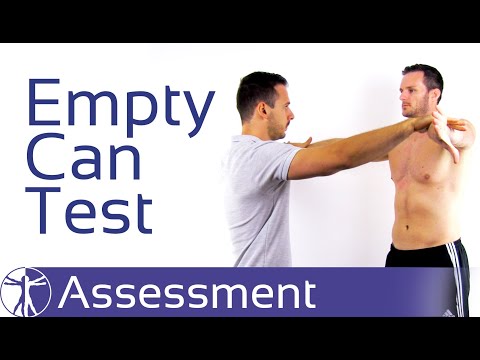
A demonstration by Physiotutors on YouTube (2:12). GymEd didn't make it, so where it differs from the steps below, follow the steps.
How to run it
- Client stands or sits. Stand facing the client.
- Client lifts both straight arms to 90 degrees in the scapular plane (about 30 to 40 degrees forward of straight out to the side), then turns them in so the thumbs point to the floor. This is the empty can version; the full can version keeps the thumbs up.
- Place a hand on each forearm just above the wrist and press down evenly and gradually while the client resists for a few seconds.
- Compare the two sides. Note any pain, but judge the result on strength.
- Positive: the arm is clearly weaker than the other side or cannot hold the position against pressure. Weakness suggests a supraspinatus (rotator cuff) tear. Pain without weakness is a weaker sign that points more to subacromial pain.
Equipment
None
Safety
Skip it with a suspected fracture, a recent dislocation or if the client cannot lift the arm to shoulder height. Build pressure gradually and stop if pain is severe. A positive is one finding, not a diagnosis: read it with the history and other tests.
How accurate is it
- Full-thickness rotator cuff tear (any)
- Sensitivity 0.74, specificity 0.77, LR+ 3.22, LR- 0.63 (Gismervik 2017, PMID 28122541; Specialist care, average prevalence 0.422 for the tear test)
- Full-thickness supraspinatus tear only
- Sensitivity 0.6, specificity 0.7, LR+ 2, LR- 0.57 (Gismervik 2017, PMID 28122541; Specialist care)
- Rotator cuff tear (any)
- Sensitivity 0.72, specificity 0.57, LR+ 1.58, LR- 0.52 (Zhao 2024, PMID 39702033; Adults with shoulder symptoms seen in shoulder clinics)
Sensitivity is how often the test is positive when the problem is there. Specificity is how often it is negative when it is not. Each figure comes from the study named, in its group of people and against its reference standard. A positive is one finding, not a diagnosis.
Sources
- Protocol Jobe FW, Moynes DR. Delineation of diagnostic criteria and a rehabilitation program for rotator cuff injuries. Am J Sports Med 1982;10(6):336-9. PMID 7180952 Itoi E, Kido T, Sano A, Urayama M, Sato K. Which is more useful, the "full can test" or the "empty can test," in detecting the torn supraspinatus tendon? Am J Sports Med 1999;27(1):65-8. PMID 9934421 Vind M, Bogh SB, Larsen CM, et al. BMJ Open 2011;1(1):e000042. PMID 22021736 (scapular plane set at 40 degrees)
- Reference Physiopedia