See it done
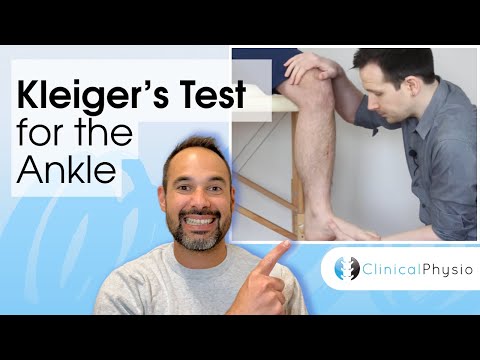
A demonstration by Clinical Physio on YouTube (2:08). GymEd didn't make it, so where it differs from the steps below, follow the steps.
How to run it
- Version: the Kleiger external rotation test with the ankle at neutral. The client sits on the edge of the bed with the knee bent to 90 degrees and the lower leg hanging relaxed.
- Steady the lower shin with one hand. With the other hand, hold the foot at neutral (90 degrees to the shin) around the heel and midfoot.
- Slowly turn the foot outwards (external rotation) while the shin stays still. Repeat on the other side.
- Ask where they feel it.
- Positive: pain at the front of the ankle over the joint between the two leg bones (the syndesmosis). It suggests a syndesmosis (high ankle) sprain. A negative does not rule the injury out.
Equipment
Plinth or examination bed
Safety
Use the Ottawa ankle rules first: if a fracture is possible, do not stress the ankle and refer for an X-ray. Turn the foot slowly and stop at the first clear pain. Done by clinicians trained in the test. A positive is one finding, not a diagnosis: read it with the history and other tests.
How accurate is it
- Ankle syndesmosis ligament injury
- Specificity 0.78 (Netterström-Wedin 2021, PMID 33774464; Pooled from studies of ankle sprains (whole review: 6 studies, 512 participants, 29% median prevalence))
Sensitivity is how often the test is positive when the problem is there. Specificity is how often it is negative when it is not. Each figure comes from the study named, in its group of people and against its reference standard. A positive is one finding, not a diagnosis.
Reliability
- Reliability
- Substantial in one study: kappa 0.75, 53 patients with ankle injuries, 9 physiotherapists in random pairs (Alonso 1998, PMID 9549711); fair in two later studies, kappa 0.399 (96 acute sprains) and 0.255 to 0.296 (105 hospital patients), both in Beynon 2022 (PMID 36536446)
Each figure comes from the study named beside it, in that study's population and protocol. Check they match your clients before you read a change as real.
Sources
- Protocol Kleiger B. The mechanism of ankle injuries. J Bone Joint Surg Am. 1956;38-A(1):59-70. PMID 13286264 Alonso A, Khoury L, Adams R. Clinical tests for ankle syndesmosis injury: reliability and prediction of return to function. J Orthop Sports Phys Ther. 1998;27(4):276-84. PMID 9549711 Netterström-Wedin F, Bleakley C. Diagnostic accuracy of clinical tests assessing ligamentous injury of the ankle syndesmosis: a systematic review with meta-analysis. Phys Ther Sport. 2021;49:214-226. PMID 33774464
- Reference Physiopedia