See it done
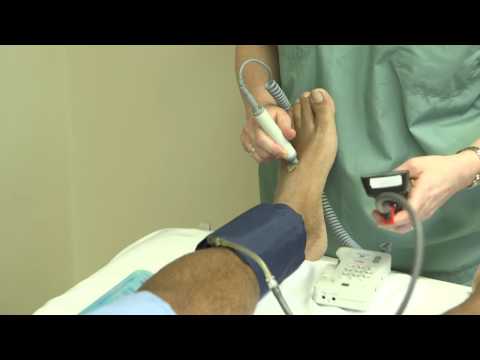
A demonstration by St. Michael's Hospital on YouTube (6:24). GymEd didn't make it, so where it differs from the steps below, follow the steps.
How to run it
- Ask the client not to smoke for at least 2 hours, and to avoid caffeine, alcohol and exercise for 2 hours, before the test. Have them lie flat and rest quietly for 10 minutes in a warm room (about 22 to 24 °C) with the arms and lower legs uncovered.
- Use cuffs whose width is at least 40% of the limb's circumference. Wrap the ankle cuff straight, just above the ankle bones (about 2 cm up). Never put a cuff over a distal bypass graft or an ulcer, and cover any other open wound with an impermeable dressing.
- For each pressure, put gel over the artery and hold the Doppler probe at 40 to 60 degrees pointing up the artery towards the heart. Inflate the cuff about 20 to 30 mmHg past the point where the signal disappears, then let it down at 2 to 3 mmHg per second; the systolic pressure is where the signal returns.
- Measure in this order: the first arm (brachial), then the posterior tibial and dorsalis pedis arteries at one ankle, then the posterior tibial and dorsalis pedis at the other ankle, then the other arm. If the first arm reads more than 10 mmHg above the other arm, measure the first arm again at the end and record that repeat in place of the first reading.
- If a signal is still heard with the cuff at 300 mmHg, let the cuff down at once and record that artery as 300 (non-compressible). If no signal can be found, record 0.
- Record each pressure in whole mmHg and, if you can hear or see it, the shape of each ankle waveform. ABI for each leg = the higher of that leg's two ankle pressures divided by the higher of the two arm pressures, to 2 decimal places.
Equipment
Hand-held Doppler with a 5 to 10 MHz probe and ultrasound gel; sphygmomanometer with arm and calf cuffs of the right size for each limb; examination couch. Optional: Doppler with a waveform display; toe cuff and photoplethysmography sensor for a toe-brachial index when the ankle arteries are non-compressible
Safety
Never put a cuff over a distal bypass graft or an ulcer, cover any other open wound with an impermeable dressing, and let the cuff down at once if a signal is still heard at 300 mmHg. Refer on per your scope (GP, vascular service or high-risk foot service) for an ABI of 0.90 or less, 0.91 to 0.99 when PAD is suspected, over 1.40, an absent or monophasic Doppler signal, or any foot wound. With a foot ulcer, an ankle pressure under 50 mmHg or an ABI under 0.4 calls for urgent vascular referral. A normal ABI does not rule out PAD, especially in diabetes.
Norms
Each band includes its lower value and runs up to, but not including, its upper value. Use the row that matches your client, and check the source's population before you read a result against it.
Abi right (ratio)
| Group | Normal (1.00 to 1.40) | Borderline (0.91 to 0.99) | Non-compressible (over 1.40): needs a toe-brachial index | Abnormal: PAD (0.90 or less) |
|---|---|---|---|---|
| Ages 18+ | 1 to 1.41 | 0.91 to 1 | 1.41 or more | Under 0.91 |
Source: 2016 and 2024 ACC/AHA lower extremity PAD guidelines (after Aboyans 2012, AHA)
Abi left (ratio)
| Group | Normal (1.00 to 1.40) | Borderline (0.91 to 0.99) | Non-compressible (over 1.40): needs a toe-brachial index | Abnormal: PAD (0.90 or less) |
|---|---|---|---|---|
| Ages 18+ | 1 to 1.41 | 0.91 to 1 | 1.41 or more | Under 0.91 |
Source: 2016 and 2024 ACC/AHA lower extremity PAD guidelines (after Aboyans 2012, AHA)
Abi right lower (ratio)
| Group | 0.9 to 1.3: PAD less likely (does not exclude it) | Above 1.3: abnormal, indicates PAD | Below 0.9: abnormal, indicates PAD |
|---|---|---|---|
| Ages 18+ | 0.9 to 1.31 | 1.31 or more | Under 0.9 |
Source: IWGDF 2023 Practical Guidelines, Appendix 2; Chuter 2022 (Australian PAD guideline)
Abi left lower (ratio)
| Group | 0.9 to 1.3: PAD less likely (does not exclude it) | Above 1.3: abnormal, indicates PAD | Below 0.9: abnormal, indicates PAD |
|---|---|---|---|
| Ages 18+ | 0.9 to 1.31 | 1.31 or more | Under 0.9 |
Source: IWGDF 2023 Practical Guidelines, Appendix 2; Chuter 2022 (Australian PAD guideline)
Reliability
- SEM
- 0.03 overall, 0.04 in people with diabetes (Casey 2020, PMID 32398142)
- Smallest real change
- 0.08 overall, 0.11 in people with diabetes (Casey 2020, PMID 32398142)
Each figure comes from the study named beside it, in that study's population and protocol. Check they match your clients before you read a change as real.
Sources
- Protocol Aboyans V, Criqui MH, Abraham P, et al; American Heart Association. Measurement and interpretation of the ankle-brachial index: a scientific statement from the American Heart Association. Circulation. 2012;126(24):2890-909. PMID 23159553 Gerhard-Herman MD, Gornik HL, Barrett C, et al. 2016 AHA/ACC Guideline on the Management of Patients With Lower Extremity Peripheral Artery Disease. Circulation. 2017;135(12):e726-e779. PMID 27840333 Gornik HL, Aronow HD, Goodney PP, et al. 2024 ACC/AHA/AACVPR/APMA/ABC/SCAI/SVM/SVN/SVS/SIR/VESS Guideline for the Management of Lower Extremity Peripheral Artery Disease. Circulation. 2024;149(24):e1313-e1410. PMID 38743805 Schaper NC, van Netten JJ, Apelqvist J, et al; IWGDF Editorial Board. Practical guidelines on the prevention and management of diabetes-related foot disease (IWGDF 2023 update), Appendix 2. Diabetes Metab Res Rev. 2024;40(3):e3657. PMID 37243927 Chuter V, Quigley F, Tosenovsky P, et al. Australian guideline on diagnosis and management of peripheral artery disease: part of the 2021 Australian evidence-based guidelines for diabetes-related foot disease. J Foot Ankle Res. 2022;15(1):51. PMID 35787293
- Reference iwgdfguidelines.org
- Norms Named under each table above. GymEd's testing library, which is coming, will use the same bands.