See it done
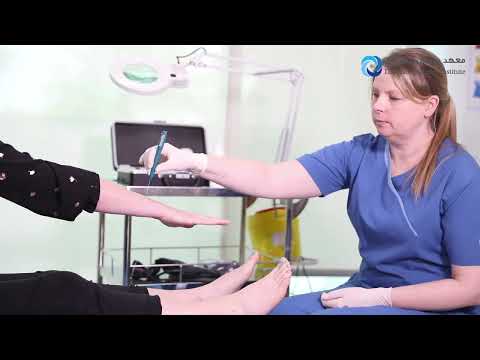
A demonstration by Dasman Diabetes Institute on YouTube (1:09). GymEd didn't make it, so where it differs from the steps below, follow the steps.
How to run it
- Explain the test, then press the filament on the client's hand (or elbow or forehead) so they know what the touch feels like.
- With the client unable to see their feet or the filament, test three sites on the sole of each foot: the big toe, the 1st metatarsal head and the 5th metatarsal head. Skip any site with an ulcer, callus, scar or dead tissue and record it as not testable.
- Hold the filament at right angles to the skin and press just hard enough to make it bend, taking about 2 seconds from touch to lift-off. Do not slide it across the skin or tap the same spot again.
- At each site ask whether they feel the touch (yes or no) and then where. Give two real touches and one pretend touch with no filament, mixed so the client cannot predict them, for three questions per site.
- Record the site as present when at least 2 of the 3 answers are right and absent when at least 2 are wrong. Encourage the client as you go.
- Look after the filament: rest it for 24 hours after testing 10 to 15 people and replace it after 70 to 90 people, as it loses force with use.
Equipment
10 g (5.07) Semmes-Weinstein monofilament. Optional: 128 Hz tuning fork or a biothesiometer or neurothesiometer for a vibration check when the monofilament result is normal (Australian guideline)
Safety
Never press the filament on an ulcer, callus, scar or dead tissue, and look over both feet first. Any site with protective sensation absent suggests loss of protective sensation and a foot at higher risk of ulceration: refer on per your scope (podiatrist, GP or diabetes team) for a full foot assessment and risk grading, and check the circulation too (pulses, ABI). Refer promptly for any wound or ulcer found. A normal result does not rule out neuropathy.
Norms
Cut-offs
- Protective sensation absent at one or more sites: refer on 1 count or more, ages 18+. Source: McMorrow 2022 (AJGP); IWGDF 2023 Practical Guidelines
Sources
- Protocol Schaper NC, van Netten JJ, Apelqvist J, et al; IWGDF Editorial Board. Practical guidelines on the prevention and management of diabetes-related foot disease (IWGDF 2023 update). Diabetes Metab Res Rev. 2024;40(3):e3657. PMID 37243927 Kaminski MR, Golledge J, Lasschuit JWJ, et al. Australian guideline on prevention of foot ulceration: part of the 2021 Australian evidence-based guidelines for diabetes-related foot disease. J Foot Ankle Res. 2022;15(1):53. PMID 35791023 McMorrow R, Nube VL, Manski-Nankervis JA. Preventing diabetes-related foot ulcers through early detection of peripheral neuropathy. Aust J Gen Pract. 2022;51(11). doi 10.31128/AJGP-06-22-6456
- Reference iwgdfguidelines.org
- Norms Named under each table above. GymEd's testing library, which is coming, will use the same bands.