See it done
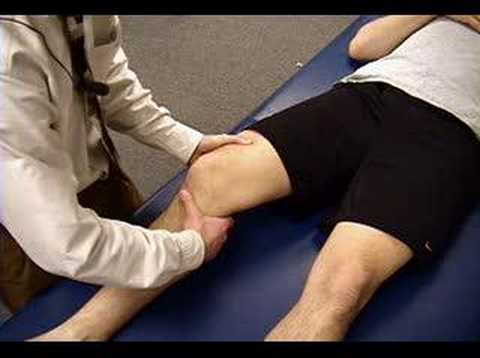
A demonstration by UW - Department of Family Medicine and Community Health on YouTube (0:36). GymEd didn't make it, so where it differs from the steps below, follow the steps.
How to run it
- Client lies on their back with the thigh muscles relaxed. Bend the knee to 20 to 30 degrees (the Lachman test at 20 to 30 degrees of knee flexion); a pillow under the thigh can hold the angle.
- Stand beside the knee being tested. Hold the lower thigh just above the knee with your outer hand. Hold the top of the shin just below the knee with your inner hand, thumb on the front of the shin near the joint line.
- Keep the thigh still and pull the shin forward firmly and quickly, without twisting it.
- Feel how far the shin moves forward and whether it stops with a firm end or a soft end.
- Test the other knee the same way and compare the two sides.
- Positive: the shin moves forward more than on the other side, or it ends softly with no firm stop. It suggests an ACL tear.
Equipment
Examination bed or plinth. Optional: Pillow or rolled towel under the thigh to hold the knee angle
Safety
Do not test if a fracture (Ottawa knee rule) or a knee dislocation is suspected: check foot pulses and feeling, and refer. Stop if pain or guarding stops the thigh muscles relaxing, as a guarded knee can hide a tear. A positive is one finding, not a diagnosis: read it with the history and other tests. Done by clinicians trained in the test.
How accurate is it
- ACL tear (partial or complete) without concomitant knee ligament injury
- Sensitivity 0.81, specificity 0.85, LR+ 5.72, LR- 0.24 (Sokal 2022, PMID 35150292; Awake patients, no arthrometry; non-obstructive meniscal tears allowed; bivariate model (the review could pool data from 12 studies this way, across all the tests))
Sensitivity is how often the test is positive when the problem is there. Specificity is how often it is negative when it is not. Each figure comes from the study named, in its group of people and against its reference standard. A positive is one finding, not a diagnosis.
Reliability
- Reliability
- kappa 0.77 inter-rater, surgeon then blinded physiotherapist within a week (36 knee-trauma patients aged 16 and over awaiting arthroscopy; Lichtenberg 2018, PMID 29568784); kappa 0.72 for the end feel grade (45 people with knee pain, two physiotherapists; Mulligan 2015, PMID 25709863)
Each figure comes from the study named beside it, in that study's population and protocol. Check they match your clients before you read a change as real.
Sources
- Protocol Torg JS, Conrad W, Kalen V. Clinical diagnosis of anterior cruciate ligament instability in the athlete. Am J Sports Med 1976;4(2):84-93. PMID 961972 Sokal PA, Norris R, Maddox TW, Oldershaw RA. The diagnostic accuracy of clinical tests for anterior cruciate ligament tears are comparable but the Lachman test has been previously overestimated: a systematic review and meta-analysis. Knee Surg Sports Traumatol Arthrosc 2022;30(10):3287-3303. PMID 35150292
- Reference Physiopedia