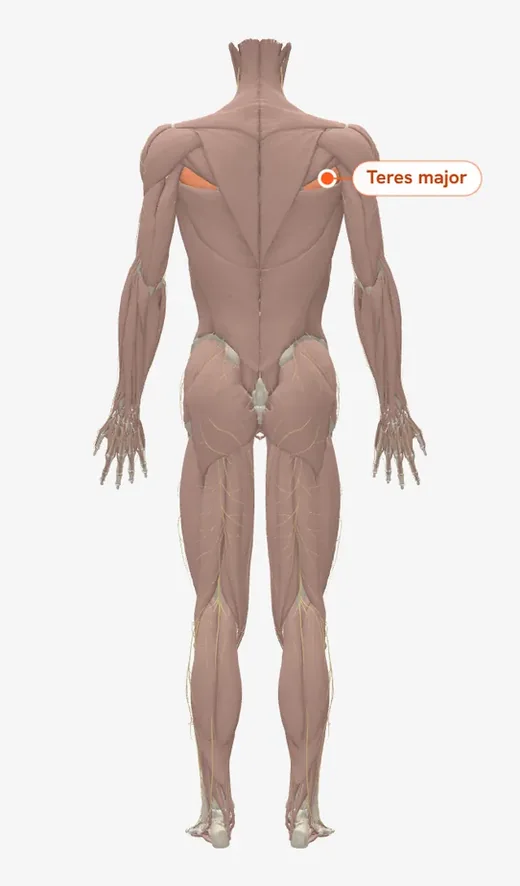
Anatomy
Teres major
A thick, flattened muscle running from the lower corner of the shoulder blade to the front of the upper arm bone. It forms part of the fold you can feel at the back of the armpit.
- Actions
- Shoulder internal rotation
- Shoulder extension, bringing the arm back from a flexed position
- Shoulder adduction
- Assists in steadying the humeral head during arm movement
- Origin
- Posterior surface of the inferior angle of the scapula and the lower part of its lateral border.
- Insertion
- Medial lip of the intertubercular groove of the humerus, also named the crest of the lesser tubercle.
- Nerve supply
- Lower subscapular nerve, a branch of the posterior cord of the brachial plexus (C5, C6, C7)
- Palpation
- Find the lateral border of the scapula and follow it down towards the inferior angle, then take the back wall of the armpit between finger and thumb. Ask for resisted adduction or internal rotation and teres major thickens towards the upper part of that fold, with the latissimus dorsi tendon wrapping around its lower border.
Clinical note. It shares extension, adduction and internal rotation with latissimus dorsi, so shortness here tends to show as a limit to overhead flexion and external rotation rather than as pain at the shoulder itself.
Sources: Kenhub: teres major muscle, StatPearls NBK580487, TeachMeAnatomy: intrinsic, openstax.org
Nerve supply
- Subscapular nerves (upper and lower) C5-C6Supplies teres major
Exercises for the teres major
227 exercises in GymEd's library load the teres major. The standard exercises come first, then the rest by how much of each exercise falls on them: prime mover first, then how concentrated it is, with a spread of movement patterns. It is a ranking of relevance, not a progression. The guides below are the highest ranked.
Most specific
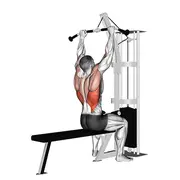 Lat pulldownCable · Sitting - chairGuide
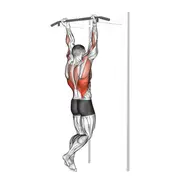 Chin-upPull-up bar · HangingGuide
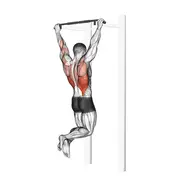 Pull-upPull-up bar · HangingGuide
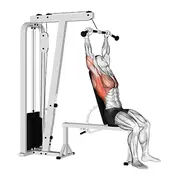 Cable seated pulloverCable · Sitting - chairGuide
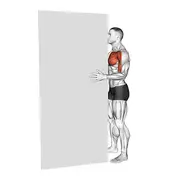 Standing internal rotation hold against wallNo equipment · StandingGuide
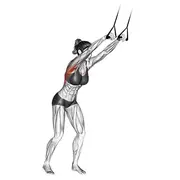 Band straight-arm pulldownResistance band · StandingGuide
No equipment 34 in the library
The full ranking is inside GymEd: all 227 exercises for the teres major, 34 with no equipment and 75 seated or lying, each demonstrated and ready to add to a program. Start free for 14 days
How to test it
Tests from the GymEd fitness test library that measure the teres major, each with its protocol, equipment, safety notes and, where a source publishes them, norms.
- Shoulder Range of Motion (ROM)Range of Motion
- Modified Ashworth Scale (MAS)Muscle Tone
- Modified Tardieu Scale (MTS)Muscle Tone