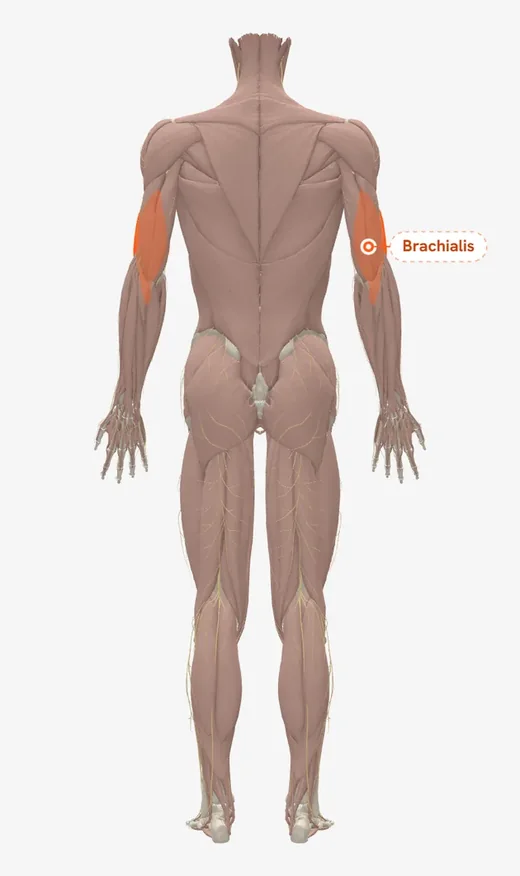
Anatomy
Brachialis
Brachialis lies in the distal part of the anterior arm, deep to biceps brachii, where it forms much of the floor of the cubital fossa. It crosses only the elbow joint and inserts on the ulna rather than the radius, so it flexes the elbow with equal effectiveness in pronation or supination. Its large cross sectional area gives it more raw flexion strength than biceps brachii, making it the primary contributor to elbow flexion in daily tasks and resisted exercise.
- Actions
- Elbow flexion
- Origin
- Distal half of the anterior surface of the humeral shaft, including its medial and lateral surfaces and the adjacent intermuscular septa
- Insertion
- Tuberosity of the ulna and the rough area on the anterior surface of the coronoid process of the ulna
- Nerve supply
- Musculocutaneous nerve, with a branch of the radial nerve additionally supplying the inferolateral fibres of the muscle's deep head (C5, C6, C7)
- Palpation
- The contracting fibres can be felt over the distal anterior arm as the patient flexes the elbow against resistance with the forearm in a semi-pronated, neutral, thumb-up position; if the muscle cannot be felt this way, brachialis strength can instead be assessed with the forearm fully pronated, which places biceps brachii, a supinator, at a mechanical disadvantage and biases the effort onto brachialis.
Clinical note. Resisting elbow flexion with the forearm pronated reduces the contribution of biceps brachii, which is also a supinator, so the test biases load onto brachialis. This is used clinically to isolate brachialis strength and to screen for brachialis strain or tendinopathy from repetitive loaded flexion, such as in climbing or heavy pull-ups.
Sources: Physiopedia: Brachialis, Kenhub: brachialis muscle, TeachMeAnatomy: brachialis, PubMed 17545433
Nerve supply
- Radial nerve C5-T1Supplies brachialis
- Musculocutaneous nerve C5-C7Supplies brachialis
Exercises for the brachialis
223 exercises in GymEd's library load the brachialis. The standard exercises come first, then the rest by how much of each exercise falls on them: prime mover first, then how concentrated it is, with a spread of movement patterns. It is a ranking of relevance, not a progression. The guides below are the highest ranked.
Most specific
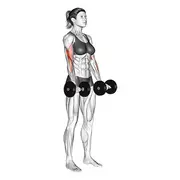 Dumbbell biceps curlDumbbell · StandingGuide
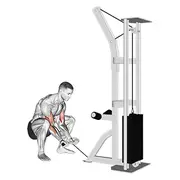 Cable squatting curlCable · StandingGuide
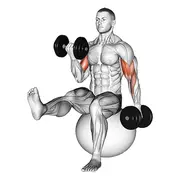 Dumbbell alternating bicep curl with leg raised on exercise ballDumbbell, Stability ball · Sitting - chairGuide
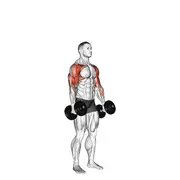 Dumbbell standing alternate hammer curl and pressDumbbell · StandingGuide
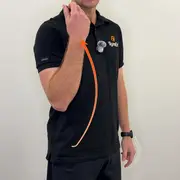 Active elbow flexionNo equipment · StandingGuide
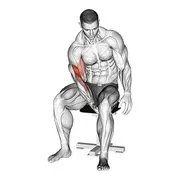 Bodyweight concentration curlNo equipment · Sitting - chairGuide
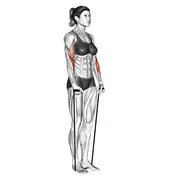 Band hammer curlResistance band · StandingGuide
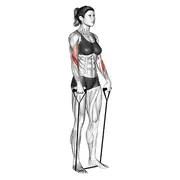 Band reverse curlResistance band · StandingGuide
No equipment 13 in the library
The full ranking is inside GymEd: all 223 exercises for the brachialis, 13 with no equipment and 107 seated or lying, each demonstrated and ready to add to a program. Start free for 14 days
How to test it
Tests from the GymEd fitness test library that measure the brachialis, each with its protocol, equipment, safety notes and, where a source publishes them, norms.
- Isolated Muscle Strength (Hand-Held Dynamometry)Muscular Strength
- Manual Muscle Testing (MMT, Oxford / MRC 0-5 grade)Muscular Strength
- Elbow Range of Motion (ROM)Range of Motion
- Modified Ashworth Scale (MAS)Muscle Tone
- Modified Tardieu Scale (MTS)Muscle Tone