See it done
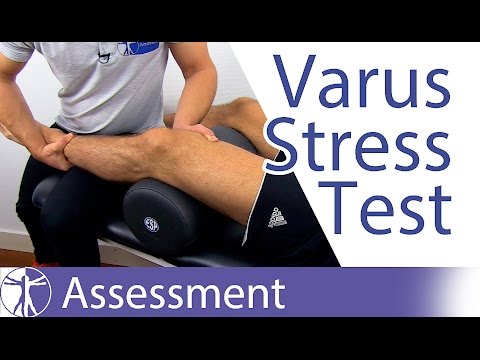
A demonstration by Physiotutors on YouTube (2:07). GymEd didn't make it, so where it differs from the steps below, follow the steps.
How to run it
- Client lies on their back, relaxed, with the leg straight on the bed. Stand on the side being tested (the varus stress test at 0 and 30 degrees of knee flexion).
- Test the straight knee (0 degrees) first: hold the inside of the knee with one hand and the outside of the ankle with the other.
- Keep the thigh still so the hip does not simply rotate. Push the knee gently outward while drawing the ankle inward (a varus force). Feel the outer joint line open and ask about pain on the outer knee.
- Bend the knee to 30 degrees, resting the thigh on the bed or your thigh, and repeat the same push.
- Test the other knee the same way at both angles and compare.
- Positive: pain on the outer side of the knee, or more opening than the other knee. At 30 degrees it suggests a lateral collateral ligament or posterolateral corner injury; opening with the knee straight suggests a more extensive injury.
Equipment
Examination bed or plinth
Safety
Suspected knee dislocation: do not test; check foot pulses, feeling on top of the foot and lifting the foot, and refer urgently. Other multiligament injury: check these first. Not with a suspected fracture (Ottawa knee rule). A positive is one finding, not a diagnosis: read it with the history and other tests. Done by clinicians trained in the test.
How accurate is it
We could not find a published accuracy figure for this test that we could check against the study itself, so none is shown. Read it with the history and your other findings.
Sources
- Protocol Hughston JC, Andrews JR, Cross MJ, Moschi A. Classification of knee ligament instabilities. Part II. The lateral compartment. J Bone Joint Surg Am 1976;58(2):173-9. PMID 1254620 LaPrade RF, Terry GC. Injuries to the posterolateral aspect of the knee. Association of anatomic injury patterns with clinical instability. Am J Sports Med 1997;25(4):433-8. PMID 9240974
- Reference Physiopedia