See it done
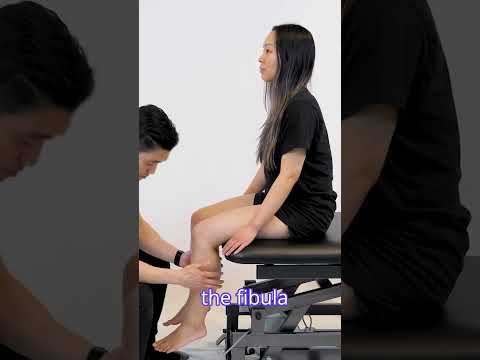
A demonstration by Physiopedia on YouTube (0:14). GymEd didn't make it, so where it differs from the steps below, follow the steps.
How to run it
- Version: Hopkinson's squeeze test at mid-calf. The client lies on their back or sits with the leg relaxed.
- Place both hands around the middle of the calf, with your fingers and thumbs on the two leg bones (the fibula on the outside and the tibia on the inside).
- Squeeze the fibula firmly towards the tibia, then let go. Do the same on the other leg for comparison.
- Ask where they feel it.
- Positive: pain low down at the front of the ankle, between the two leg bones (the syndesmosis), away from where you squeezed. It suggests a syndesmosis (high ankle) sprain. Calf tenderness under your hands alone is not a positive, and a negative does not rule the injury out.
Equipment
Plinth or examination bed
Safety
Use the Ottawa ankle rules first: if a fracture is possible, do not squeeze and refer for an X-ray. Severe pain with a tense, swollen calf needs urgent medical review, not testing. Squeeze at mid-calf, not near the knee. A positive is one finding, not a diagnosis: read it with the history and other tests.
How accurate is it
- Ankle syndesmosis ligament injury
- Specificity 0.85 (Netterström-Wedin 2021, PMID 33774464; Pooled from studies of ankle sprains (whole review: 6 studies, 512 participants, 29% median prevalence))
Sensitivity is how often the test is positive when the problem is there. Specificity is how often it is negative when it is not. Each figure comes from the study named, in its group of people and against its reference standard. A positive is one finding, not a diagnosis.
Reliability
- Reliability
- Moderate: kappa 0.50, 53 patients with ankle injuries, 9 physiotherapists in random pairs (Alonso 1998, PMID 9549711); kappa 0.450 in 96 acute sprains and 0.296 to 0.320 in 105 hospital patients (Großterlinden and Hosseinian, both in Beynon 2022, PMID 36536446)
Each figure comes from the study named beside it, in that study's population and protocol. Check they match your clients before you read a change as real.
Sources
- Protocol Hopkinson WJ, St Pierre P, Ryan JB, Wheeler JH. Syndesmosis sprains of the ankle. Foot Ankle. 1990;10(6):325-30. PMID 2113510 Netterström-Wedin F, Bleakley C. Diagnostic accuracy of clinical tests assessing ligamentous injury of the ankle syndesmosis: a systematic review with meta-analysis. Phys Ther Sport. 2021;49:214-226. PMID 33774464
- Reference Physiopedia